
People don’t share adverts. They share entertainment.
That was the message from this year’s 72Fest, where social media leaders and creators explored what it really takes to build audiences, create content people want to watch and turn online communities into something bigger than a follower count.
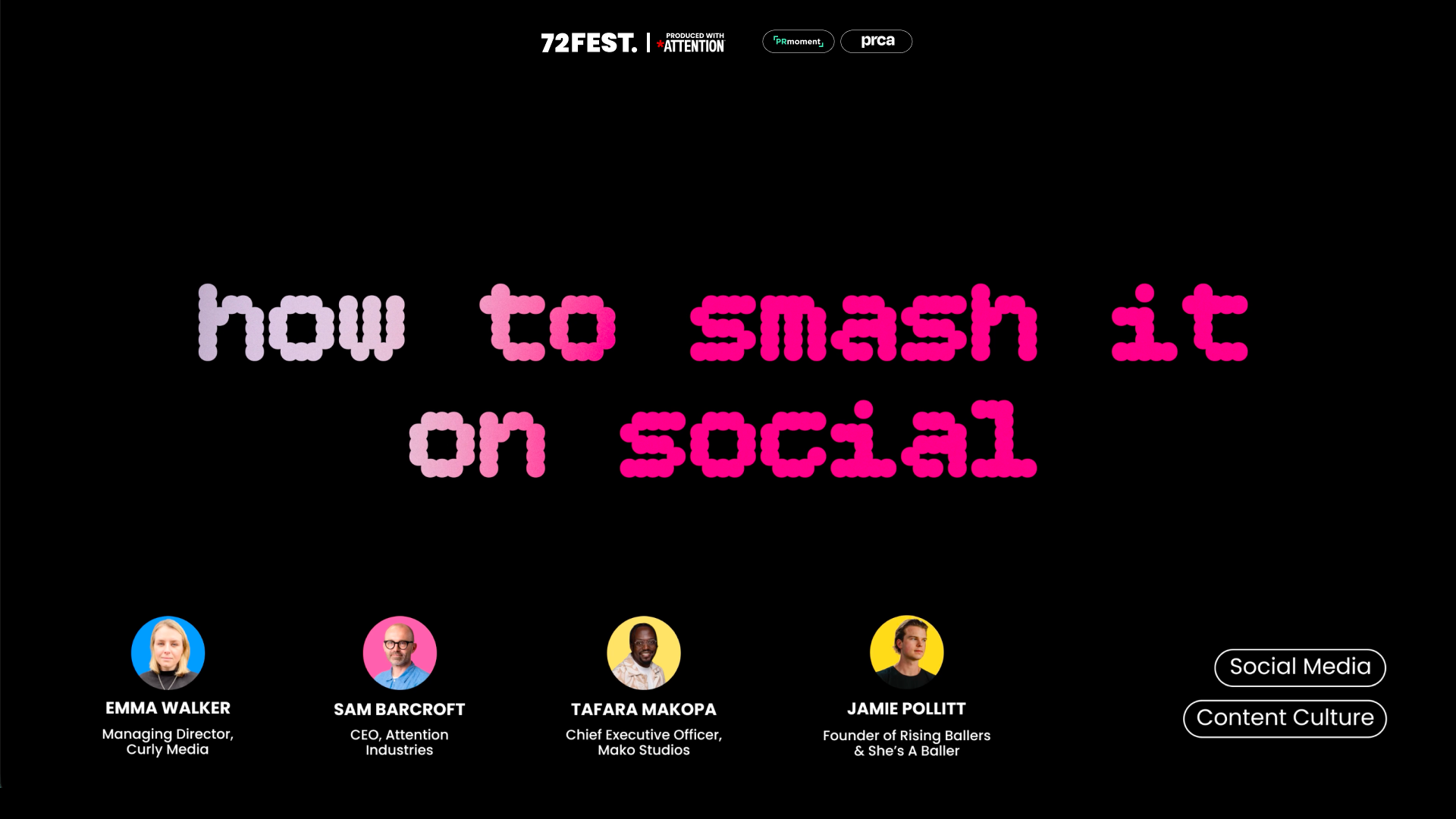
Moderated by Sam Barcroft, How to Smash It on Social: Creators, Communities and Content That Wins brought together Emma Walker, Founder and Managing Director of Curly Media; Jamie Pollitt, Co-Founder of Rising Ballers; and Tafara Makopa, a pioneer of digital-first entertainment formats and social strategy.
From Spotify Wrapped to creator-led YouTube shows and grassroots football, the panel shared how brands can move beyond traditional promotion and become part of the culture their audiences care about.
Stop making adverts. Start making entertainment.
For Emma Walker, the problem with much of branded social content is that it starts with what a business wants to say, rather than what an audience wants to watch.
Curly Media was built around a different approach: creating social-first entertainment that gives people a reason to engage and share.
The agency has worked with brands including Spotify, Netflix, Sky and WeTransfer, developing everything from always-on social content to major campaign moments.
One standout example was Curly’s work on Spotify Wrapped. Rather than relying on a traditional promotional film, the campaign brought together some of the UK’s biggest artists and cultural references from the year, creating content designed to resonate with fans and online communities.
The result became Spotify’s best-performing Wrapped campaign to date, according to Walker.
She credited the success in part to Spotify’s willingness to trust its agency partners and listen to its audience, rather than relying solely on internal opinions. That trust, she explained, had been built through years of collaboration and consistently delivering strong work.
Find creativity where culture is happening
Walker also shared how Curly Media approaches creative recruitment, looking beyond traditional industry routes to find people already shaping online culture.
That can mean identifying talent through fan pages, creator communities and social accounts that have built loyal audiences around a shared interest.
The thinking is simple: people who understand internet culture are often the people creating it. Bringing that instinct together with experienced strategists, marketers and producers helps turn community-led creativity into work that can deliver for major brands.
It is a reminder that understanding an audience is not just about analysing data. Sometimes, it starts with the people already participating in the conversation.
Build formats, not just viral moments
Tafara Makopa reflected on the early days of creator-led entertainment, when brands were still learning how to work with digital personalities and the communities they had built.
Rather than viewing followers as numbers, Makopa recognised that creators had established relationships with audiences who trusted them. The opportunity for brands was to become part of those communities in a way that felt natural.
Footasylum was one example. Looking to evolve beyond its role as a retailer and become part of youth culture, the brand invested in creator-led entertainment formats including Does The Shoe Fit?, Chef Asylum and Truth Asylum.
These shows went beyond product promotion, giving audiences entertainment they could actively choose to watch.
For Makopa, this highlights the difference between a viral moment and a repeatable format. A single post might generate a burst of attention, but a strong format can keep bringing audiences back over time.
That distinction is particularly important for brands investing in YouTube and longer-form content, where sustained engagement can be just as valuable as an individual viral hit.
Making branded entertainment more accessible
High-quality video production can be expensive, particularly for brands exploring longer-form entertainment for the first time.
Makopa discussed an approach known as ‘brand clustering’, which brings together complementary businesses targeting similar audiences to share the investment in a production.
For example, a fashion brand, restaurant group and technology company might all appeal to the same audience. By collaborating on a relevant format, they can share production costs while reaching consumers in a way that feels cohesive.
The approach offers a potential route for brands to explore richer entertainment without having to fund an entire production independently.
Turn an online community into real-world impact
Jamie Pollitt shared how Rising Ballers grew from an Instagram page celebrating young football talent into a media brand and community with millions of followers.
At a time when mainstream football coverage largely focused on established stars, Rising Ballers chose to spotlight the next generation. By building relationships with young players before they reached the professional game, the platform developed credibility and a loyal audience.
But the ambition went beyond social content.
Rising Ballers launched its own football team and organised showcase events to help talented players get noticed. Pollitt highlighted how this approach had helped players secure professional opportunities, demonstrating how an online community can create tangible value in the real world.
The platform’s partnership with Puma provides another example. After seeing the success of Rising Ballers’ grassroots showcase format, Puma backed the initiative as part of a football boot launch, with the partnership expanding internationally.
Rather than building a campaign around an audience from scratch, the brand invested in a community that already existed.
Let creators lead
Across the discussion, the panellists returned to the importance of collaboration and trust.
The strongest brand partnerships do not treat creators as simply another distribution channel. They recognise the knowledge creators have built through their relationships with audiences and give them room to bring that understanding into the work.
That means listening to creators, involving communities in the creative process and resisting the urge to control every detail.
It also means looking beyond surface-level demographics. Brands need to understand what their audiences care about, which voices they trust and what makes them want to participate.
The takeaway: become part of the culture
The discussion at 72Fest reinforced a simple lesson: winning on social is not about producing more content. It is about creating content people genuinely want to engage with.
Whether through entertainment-led campaigns, repeatable video formats or communities that create real-world opportunities, the strongest examples started with an understanding of the audience.
The brands making an impact are those willing to trust creators, invest in communities and give people something worth sharing.
Because the most successful social strategies do not interrupt culture. They become part of it.