
AI search is changing how people discover information, research brands and make decisions. For PR agencies, that presents a new challenge and a significant opportunity.
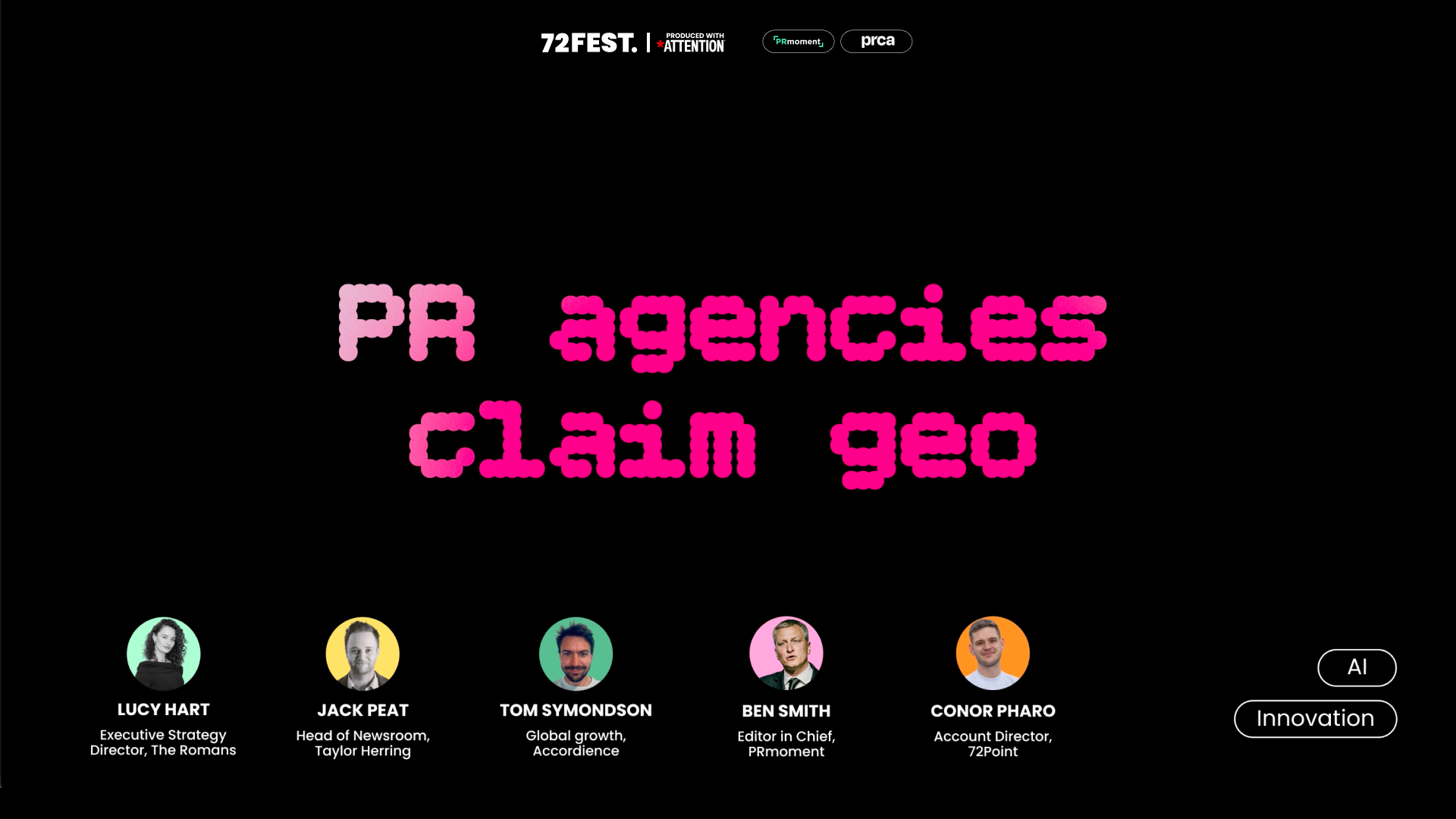
At this year’s 72Fest, PR Agencies Claim GEO brought together experts from across communications, data and technology to explore how Generative Engine Optimisation (GEO) is reshaping the industry, and why earned media could become even more valuable in an AI-driven search landscape.
Moderated by Ben Smith, Editor-in-Chief of PRmoment, the panel featured Lucy Hart, Executive Strategy Director at The Romans; Tom Symondson, Global Growth at Accordience; Jack Peat, Head of Newsroom; and Conor Pharo, Account Director at 72Point.
The discussion explored how brands can improve their visibility in AI-generated answers, why traditional media relations still matter and how agencies can adapt their strategies as search behaviour evolves.
Is good PR already GEO?
One of the first questions was whether agencies that have always delivered strong media relations are already doing GEO.
The answer was both yes and no.
Traditional media coverage remains an important foundation, but appearing in the right places is only part of the picture. AI systems need credible information, authoritative sources and content that helps answer specific questions.
For PR teams, this means looking beyond coverage volume and considering how the stories, expertise and information they create contribute to a brand’s wider online presence.
The opportunity is not simply to generate more mentions. It is to ensure that brands are represented accurately and credibly in the places AI systems draw upon.
Humans like stories. Machines like structure.
Lucy Hart highlighted one of the key challenges for agencies: adapting communications thinking for an environment in which information is consumed by both people and AI systems.
Traditional PR focuses on stories that resonate with human audiences. GEO adds another consideration: whether information is structured, accessible and clear enough for AI systems to interpret.
As Hart put it, “Humans like stories. Machines like structure.”
Creativity and storytelling remain important, but agencies also need to think about where information appears online, how it is presented and how AI tools retrieve and use it.
This makes GEO more than a media relations exercise. It requires an understanding of content, technology, data and the ways people search for information.
Building tools for the AI era
The panel highlighted how agencies are developing technology to help brands understand and improve their visibility in AI search.
The Romans has developed Serpent, its GEO analysis platform, while Accordience’s GeoRadar has evolved from a visibility tracking tool into a broader reputation and market intelligence platform operating across 30 markets and multiple languages.
Jack Peat discussed Taylor Herring’s work within Publicis Groupe’s data ecosystem, while Conor Pharo reflected on the launch of Generate, Attention Industries’ GEO platform, unveiled earlier that day at 72Fest.
Although the approaches differ, these tools share a common objective: helping brands understand where they appear in AI-generated responses, which sources are being referenced, how competitors perform and where visibility gaps exist.
That information can help communications teams identify opportunities and make more informed strategic decisions.
Why mentions alone won’t win
A brand appearing in an AI-generated answer does not automatically mean its GEO strategy is working.
Pharo highlighted the importance of looking at the questions people actually ask, particularly specific queries that may indicate they are researching options or moving closer to a decision.
Rather than concentrating exclusively on broad category searches, brands can investigate more detailed questions about product features, reputation, expertise, performance and trust.
Understanding how AI responds to those prompts can reveal how a brand is being positioned against competitors, what information is missing and where inaccurate descriptions may need addressing.
For communications teams, this creates an opportunity to move beyond counting mentions and towards understanding the quality and context of a brand’s visibility.
Earned media still matters
One of the central questions was whether PR or SEO will ultimately shape AI search.
Hart argued that PR remains well positioned because earned media provides access to trusted editorial environments and authoritative sources.
Journalism, expert commentary, thought leadership and credible third-party content can all help establish the information and reputation associated with a brand.
The panel’s message was not that traditional PR can simply be relabelled as GEO. Rather, the fundamentals of good communications remain valuable, while agencies need to understand how those fundamentals translate into AI search visibility.
The opportunity lies in combining strong storytelling and media relations with a more deliberate approach to discoverability.
Breaking down the silos
GEO is also encouraging closer collaboration between teams that have traditionally worked separately.
Data analysts can identify patterns, competitor activity and gaps in visibility. PR teams can turn those findings into relevant stories, expert commentary and campaigns. Researchers and content specialists can help ensure that the resulting information is useful, credible and accessible.
Peat highlighted the value of this collaboration, noting that different disciplines bring distinct skills to the process.
Rather than treating GEO as the responsibility of one team, agencies can benefit from bringing data, communications, creativity and strategy together.
Start testing before building a strategy
For brands at the beginning of their GEO journey, Pharo recommended starting with a practical exercise: identify the questions potential customers might ask about the brand, then test how AI systems respond.
This can help teams establish:
- Where the brand appears and which competitors are mentioned.
- Which sources AI systems cite.
- Whether information about the brand is accurate.
- Which topics or questions are missing from existing content.
- Where opportunities exist to strengthen visibility and authority.
These findings can provide a starting point for deciding what to improve, what content to develop and which areas deserve further investigation.
Connect GEO to business outcomes
As interest in GEO grows, Symondson cautioned against treating it as a standalone solution or isolated measurement.
Understanding how AI describes a brand is useful, but it should sit alongside broader analysis of reputation, stakeholder perceptions, media coverage and audience behaviour.
The panel also explored how AI search could create opportunities to connect PR with outcomes further down the marketing funnel. As consumers increasingly use AI tools to research products and compare options, communications may influence not only awareness but also consideration and intent.
The challenge for agencies is to establish meaningful measures and understand how AI visibility relates to the outcomes that matter to each business.
What comes next for GEO?
The panel agreed that the GEO landscape will continue to evolve, making flexibility and experimentation essential.
Hart pointed to growing concerns around AI-generated content and the prospect of an internet increasingly populated by machine-produced material. Pharo highlighted the potential for AI analysis to uncover insights that brands may previously have overlooked, helping teams identify opportunities and problems earlier.
For agencies, the task is to keep testing, learn how AI systems represent their clients and adapt as technology and audience behaviour change.
The takeaway from 72Fest was clear: GEO is not replacing PR. It is creating a new opportunity for communications professionals to demonstrate the value of credible information, authoritative voices and earned media.
The agencies that succeed will be those that combine strong communications with useful, trustworthy and discoverable content and connect that visibility to meaningful business results.